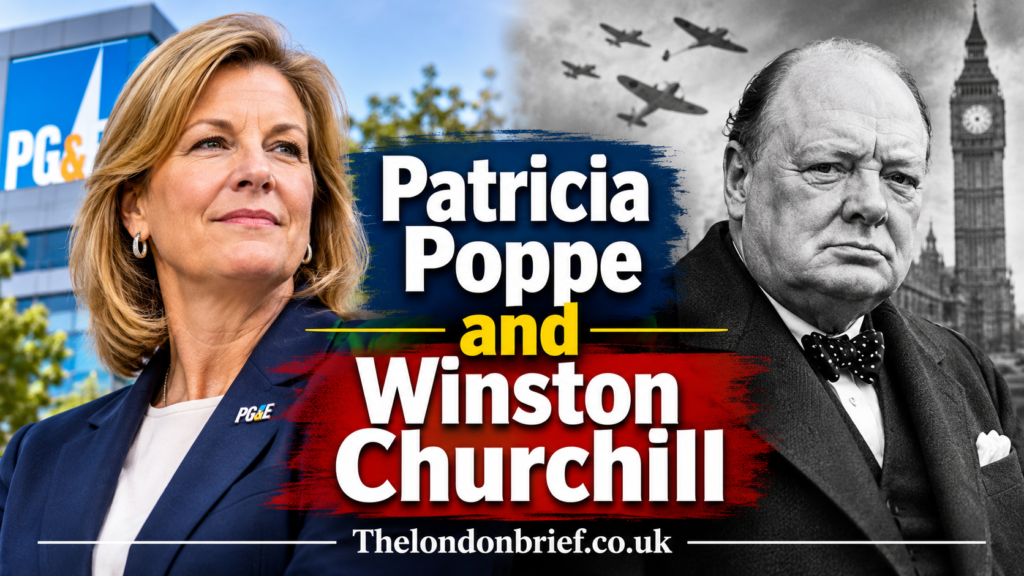

The pairing of Patricia Poppe and Winston Churchill may seem unusual, since one runs a modern California utility and the other guided Britain through its darkest war years. Still, leadership under pressure has a familiar shape in every century. There is no public record of a direct link between the two, so this article uses Churchill as a measuring stick for how Poppe has handled a company in crisis. Treat it as a comparison built on checkable facts, not a claim that she modeled herself on him.
Why Compare These Two Leaders?
Comparisons across eras work best when they focus on behavior rather than résumés. Churchill led a nation at war, while Poppe leads an energy company that millions of people rely on every day. Both stepped into roles where trust was low and the old approach had clearly failed. That shared starting point makes the comparison useful, because each faced the same question: how do you rebuild belief when people have good reasons to doubt you?
Who Is Patti Poppe?
Patricia “Patti” Poppe spent about fifteen years at General Motors and later earned a management degree from Stanford. She became president and CEO of CMS Energy in Michigan in 2016, and PG&E named her chief executive effective January 4, 2021. Her background is operational rather than political, which shapes how she talks about safety, reliability and cost. PG&E now serves more than 16 million Californians, which makes her one of the most closely watched executives in American energy.
How Churchill Led in a Crisis
Winston Churchill served as prime minister from 1940 to 1945 and again from 1951 to 1955. During the 1930s, often called his wilderness years, he concentrated on writing rather than holding high office. When he addressed the House of Commons in May 1940, in the speech remembered for its blood, toil, tears and sweat theme, he offered sacrifice instead of comfort. That honesty became his signature: tell people the truth first, then give them a reason to keep going.
Rebuilding Trust After Failure
When Poppe was hired, PG&E had only recently emerged from bankruptcy brought on by wildfires tied to its aging equipment. More than 120 people died in fires linked to that equipment during 2017 and 2018, and a leading consumer advocacy group doubted that one new chief executive could change the company’s course. In a late-2025 statement, the company reported zero major wildfires caused by its equipment over the previous three years. Churchill also took charge when a nation’s confidence was shaken, and in both cases credibility had to be earned through visible results rather than promises.
Two Very Different Voices
Churchill used grand, carefully built speeches to steady a frightened public. Poppe speaks in a plainer and more personal register, and she has said openly that she loves PG&E’s customers and hometowns. When the company released its 2026 sustainability report, she described the progress as proof that leading with love works. The styles could hardly differ more, yet both leaders understood that people follow someone who sounds like they mean what they say.
Playing the Long Game
Churchill’s wartime leadership demanded patience as much as courage. Poppe’s version of patience is a capital plan. The latest report shows $11.8 billion invested in safety, reliability, decarbonization and wildfire mitigation, with 72 percent of the electricity PG&E sells directly coming from greenhouse gas-free sources. She has also been candid about limits: PG&E cut its planned 2027 investment by about $2 billion, to $11.4 billion, after wildfire liability reform fell short. She has called the company’s credit rating a major issue that needs a legislative solution, and admitting constraints in public is its own kind of leadership.
Where the Comparison Breaks Down
It would be unfair to push the parallel too far. Churchill held extraordinary wartime authority and faced an existential threat, yet voters ended his wartime premiership in the 1945 general election. Poppe answers to regulators, a board, shareholders and customers who pay monthly bills, which is a very different kind of accountability. A utility rate case is not a war, and honest analysis keeps those stakes in proportion. The value of the comparison lies in the habits of mind, not in the size of the stage.
Practical Takeaways for Today’s Leaders
Start by describing the problem honestly before you promise a fix, because people can tell when they are being managed. Then measure progress in ways outsiders can verify, since trust follows evidence far more reliably than it follows enthusiasm. Remember too that a reputation rebuilt over years can be damaged in a single bad season, so consistency matters more than any single announcement. Anyone who studies the pairing of Patricia Poppe and Winston Churchill gets a useful reminder that crisis leadership is mostly steady behavior repeated until people believe it.
Frequently Asked Questions
Is there a documented connection between Patricia Poppe and Winston Churchill?
No documented link exists. The comparison in this article is analytical, drawn from public information about each leader’s career and decisions.
What is Patti Poppe’s current role?
She is CEO of PG&E Corporation, and she announced a commitment to serve an additional five years in the role. Coverage from October 2026 still identifies her as CEO.
What is Winston Churchill best remembered for?
He guided Britain as prime minister during the Second World War, and a 2002 BBC poll voted him the greatest Briton.
What can business leaders learn from this comparison?
Honesty about hard realities, progress that others can verify, and patience through long rebuilding efforts are the common threads. Neither leader relied on charm alone.
Conclusion
The story of Patricia Poppe and Winston Churchill is not about a shared history, because none exists. It is about how leaders who inherit broken trust can rebuild it through candor, steady work and results that others can check. Their settings, powers and voices differ enormously, yet the core test is the same. For anyone interested in leadership, that makes the comparison worth remembering.