
What Is Parentification?
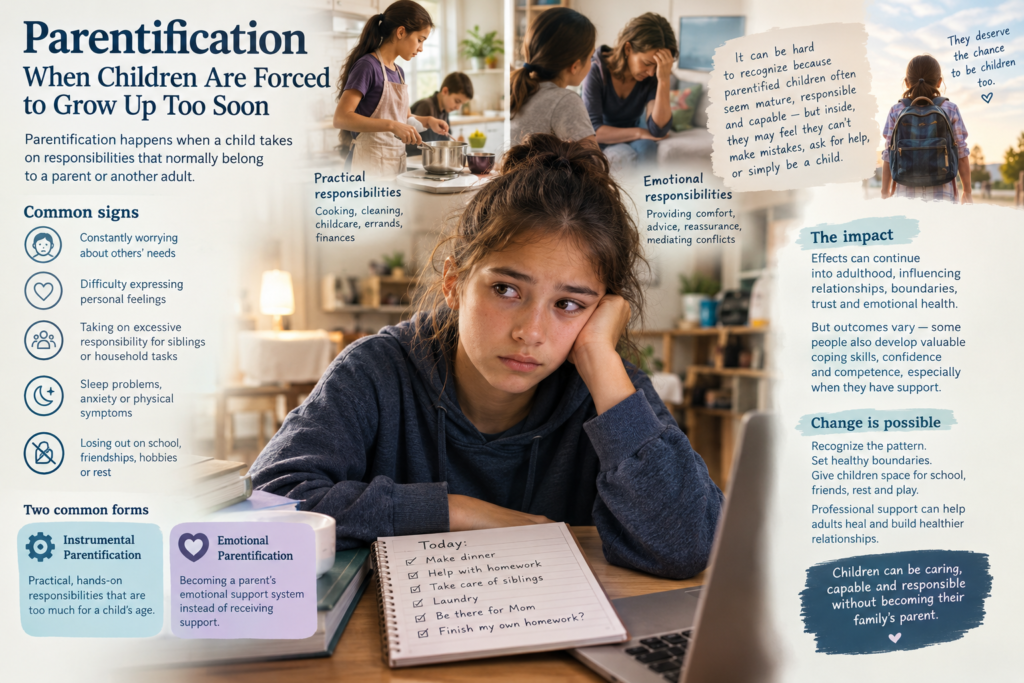
Parentification describes a family dynamic in which a child takes on responsibilities that normally belong to a parent or another adult. A child may become responsible for younger siblings, household tasks, finances, or even a parent’s emotional well-being. Helping at home is a normal part of growing up, but the situation becomes concerning when responsibilities are excessive, age-inappropriate, or interfere with the child’s own emotional and developmental needs.
The idea can be difficult to recognize because parentified children often appear unusually mature, responsible, dependable, and capable. From the outside, they may seem like the child who always has everything under control. Inside, however, they may feel that they cannot make mistakes, ask for help, or simply behave like a child.
Research shows that the experience is not identical for every family or child. The effects can depend on the child’s age, the type and duration of responsibility, family support, cultural expectations, and whether the child feels appreciated or trapped by the role. A major research review examining 95 studies found both negative and positive outcomes, showing why the family context matters when understanding this experience.
How Parentification Happens
Parentification can develop when a family is experiencing circumstances that make normal parenting difficult. A parent’s serious illness, disability, substance-use problems, financial hardship, divorce, death, incarceration, or other major crisis may leave children taking on responsibilities that adults would normally manage. Family conflict and unstable home environments can also contribute to this role reversal.
Sometimes the situation develops gradually rather than through one dramatic event. An older child may begin looking after younger brothers or sisters because a parent is working long hours. Over time, that occasional help can become an expectation. The child may eventually feel responsible for meals, school routines, household organization, or keeping everyone calm.
It is important not to assume that every child who helps at home is being parentified. Children can benefit from age-appropriate chores, sibling care, and family responsibilities. Research emphasizes that caregiving by itself does not automatically mean parentification; the surrounding family relationship, the level of responsibility, the child’s adjustment, and whether appropriate parental support remains available are important factors.
Two Common Forms of Parentification
Instrumental Parentification
Instrumental parentification involves practical responsibilities that are too demanding for a child’s age or circumstances. A child might regularly prepare meals, manage household duties, care for younger siblings, handle important errands, or become involved in financial responsibilities that should primarily belong to adults.
There is nothing unusual about asking children to clean their room, help with dishes, or occasionally watch a younger sibling. The concern arises when these duties become excessive, unavoidable, or essential to keeping the household functioning. A child who feels that the family cannot cope without them may be carrying a burden far beyond normal childhood responsibility.
Emotional Parentification
Emotional parentification can be less visible but deeply significant. It happens when a child becomes a parent’s emotional support system rather than receiving appropriate emotional support from the parent.
For example, a parent may repeatedly depend on a child for comfort, advice, reassurance, or help during adult conflicts. The child may become the person who listens to relationship problems, mediates arguments, or tries to prevent a parent from becoming upset. Researchers have distinguished emotional responsibilities from practical caregiving because the psychological boundary between parent and child can become blurred.
Signs a Child May Be Carrying Too Much
A child experiencing excessive family responsibility may constantly worry about other people’s needs while ignoring their own. They may become highly sensitive to conflict and believe it is their job to keep everyone happy.
Other signs can include difficulty expressing personal feelings, guilt when saying no, fear of making mistakes, excessive responsibility for siblings, or discomfort with receiving help. Some children may also experience stress-related physical complaints, sleep difficulties, anxiety, social challenges, or changes in appetite. These signs do not prove parentification on their own, but they can indicate that a child needs closer attention and support.
Another important sign is the loss of ordinary childhood experiences. A child who regularly sacrifices schoolwork, friendships, hobbies, rest, or personal interests because the family depends on them may be dealing with responsibilities that have become developmentally inappropriate.
How It Can Affect Adult Relationships
The effects of parentification can continue into adulthood, particularly when a person grows up believing that their value depends on taking care of others. Someone who was expected to be the dependable person in the family may find it difficult to relax or allow another person to take responsibility.
Some adults may struggle with boundaries, guilt, trust, emotional expression, or asking for assistance. They might automatically become the problem-solver in relationships and feel uncomfortable when someone else needs to care for them. Research has connected difficult forms of childhood parentification with emotional, behavioral, relationship, and physical-health challenges, although outcomes vary considerably from person to person.
At the same time, it would be misleading to describe every former parentified child as permanently damaged. Research has also found potentially positive outcomes, including coping skills, confidence, responsibility, and competence. In some circumstances, caregiving may help young people develop valuable abilities, particularly when their efforts are supported and recognized rather than exploited.
Parentification Is Not Always Simple to Identify
One reason the subject can be confusing is that family caregiving exists on a wide spectrum. In many households, older children naturally help younger siblings or assist parents during difficult periods. Cultural expectations can also influence what different families consider normal responsibility.
The important question is not simply whether a child helps. It is whether the responsibility is appropriate for the child’s age, whether adults remain responsible for parenting, whether the child has adequate support, and whether the role interferes with healthy development.
A study of children’s responses to parental conflict illustrates this complexity. Although many children demonstrated caregiving behaviors, researchers found that considering the broader family context produced a much lower estimate of parentification. This supports the idea that behavior should not be interpreted without understanding the child’s family relationships and overall adjustment.
Can the Pattern Be Changed?
Families can begin by recognizing that children should not have to become the emotional or practical foundation of the household. Parents facing illness, financial stress, separation, or another crisis may genuinely need help, but acknowledging a child’s contribution and protecting their boundaries can make an important difference.
Open communication is especially valuable. Parents can explain difficult circumstances without making a child responsible for solving them. They can also make room for school, friendships, rest, play, and age-appropriate independence.
For adults who recognize these patterns from their own childhood, professional support can help them understand boundaries, relationships, emotional needs, and long-established beliefs about responsibility. A qualified mental-health professional can help someone explore these experiences without assuming that every family difficulty has the same cause or outcome.
Frequently Asked Questions
What does parentification mean?
Parentification means a child takes on adult-like practical or emotional responsibilities that are beyond what would normally be expected for their age and developmental stage.
Is taking care of siblings always parentification?
No. Helping with younger siblings can be a normal family responsibility. It becomes concerning when the child carries excessive responsibility, lacks appropriate adult support, or sacrifices important developmental needs.
What is emotional parentification?
Emotional parentification occurs when a child becomes responsible for meeting a parent’s emotional needs, such as providing adult-level comfort, advice, reassurance, or mediation.
Can parentification have positive effects?
Research indicates that some young people develop useful coping abilities, confidence, responsibility, or practical skills. However, positive outcomes do not mean that excessive responsibility is harmless. The circumstances and level of support matter.
Can adults recover from childhood parentification?
People can develop healthier boundaries and relationship patterns as adults. Understanding the childhood role, recognizing personal needs, and working with an appropriately qualified professional can be useful steps.
Final Thoughts
Parentification is ultimately about more than a child doing chores or helping a family during a difficult period. The central concern is a reversal of roles in which a child is expected to carry responsibilities that should remain primarily with adults. Research shows that its effects can differ widely, making family circumstances, support, culture, age, and the type of responsibility important parts of the picture.
Children can be caring, capable, and responsible without becoming their family’s parent. Healthy family relationships allow children to contribute while still giving them space to learn, make mistakes, develop independence, and receive care themselves. Recognizing that balance can be an important step toward creating a family environment where children are allowed to grow without feeling that the entire household depends on them.