
Manchester United has been shaped by some of football’s most recognizable figures, and the story of Man Utd managers spans more than a century of changing tactics, personalities, players, and expectations. From Ernest Mangnall and Sir Matt Busby to Sir Alex Ferguson and the modern era, each manager has left a different mark on the club.
Manchester United was founded in 1878 as Newton Heath before adopting its current name in 1902. The club eventually became one of England’s most successful football institutions, with managers playing a central role in its transformation.
The Early Manchester United Managers
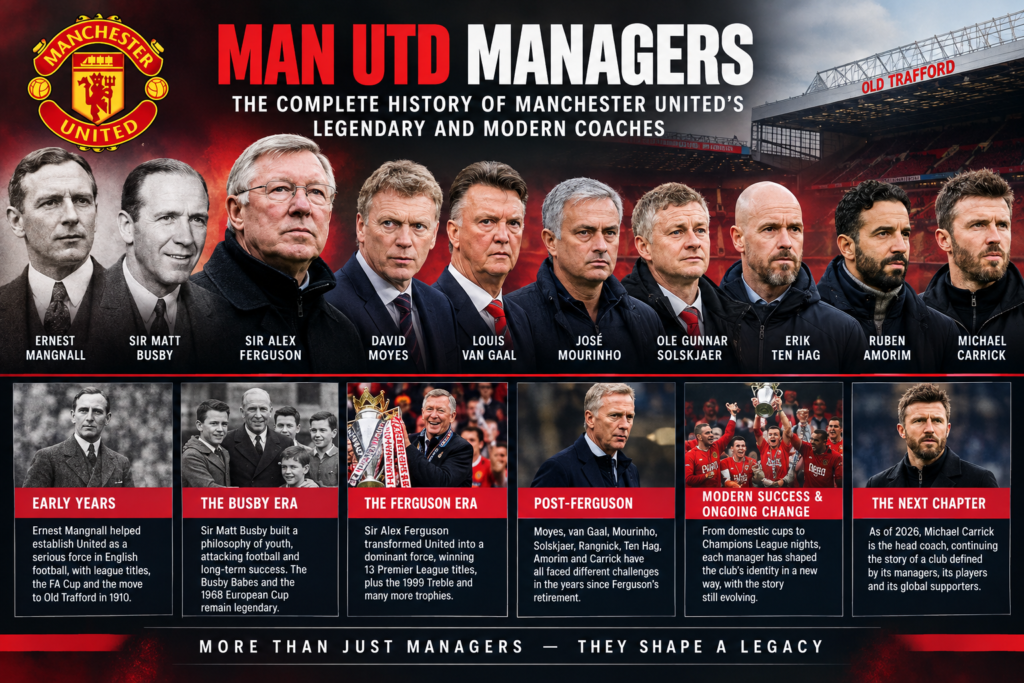
Manchester United’s first decades were very different from the modern Premier League era. One of the most important early figures was Ernest Mangnall, who helped establish the club as a serious force in English football during the early 20th century.
Under Mangnall, United won league titles and the FA Cup, while the move to Old Trafford in 1910 helped establish the stadium as the club’s long-term home. His tenure remains an important part of the foundation on which Manchester United later built its reputation.
The club then faced several difficult periods, including financial problems, leadership changes, and inconsistent performances. The managerial position became increasingly important as United tried to compete with England’s strongest clubs.
Sir Matt Busby Changed Everything
When discussing Man Utd managers, Sir Matt Busby is impossible to overlook. Busby arrived in the 1940s and created a football philosophy that emphasized youth development, attacking football, and long-term team building.
His most famous creation was the group known as the Busby Babes. These young players helped United win league titles during the 1950s and became one of the most celebrated young teams in football history.
The Munich air disaster of 1958 devastated the club, with eight first-team players among those who died. Busby survived and eventually rebuilt the team, leading United toward another remarkable period.
The rebuilding process eventually produced a side featuring players such as Bobby Charlton, Denis Law, and George Best. In 1968, Manchester United won the European Cup, becoming the first English club to lift the trophy.
A Difficult Period After Busby
After Busby’s retirement, Manchester United entered a much less stable period. The club went through several managers, including Wilf McGuinness, Frank O’Farrell, Tommy Docherty, Dave Sexton, and Ron Atkinson.
Tommy Docherty brought an important revival during the 1970s. United won the FA Cup in 1977, although the decade also included the shock of relegation from the top division.
Ron Atkinson later brought renewed optimism in the 1980s. His teams won cups, but the league title remained out of reach. The search for a manager who could restore United to sustained domestic dominance eventually led to one of the most consequential appointments in the club’s history.
Sir Alex Ferguson’s Extraordinary Era
Sir Alex Ferguson became Manchester United manager in 1986, beginning a reign that would eventually become the defining managerial chapter in the club’s modern history. His early years were challenging, but he gradually laid the foundations of a new team.
Ferguson’s management combined strong discipline with an emphasis on developing young players. The emergence of the Class of ’92, including David Beckham, Ryan Giggs, Paul Scholes, Gary Neville, and Phil Neville, became one of the clearest examples of United’s long-term youth philosophy.
The breakthrough came in the early 1990s. United won the Premier League title in 1992–93, ending a long wait for a league championship. Ferguson then built teams that could repeatedly compete for domestic and European honors.
The 1998–99 season became particularly historic. Manchester United won the Premier League, FA Cup, and Champions League to complete an extraordinary Treble. The club later continued its domestic success, with Ferguson eventually collecting 13 Premier League titles during his tenure.
Ferguson retired at the end of the 2012–13 season after guiding United to another Premier League title. His departure represented a major turning point because the club had become closely associated with his leadership for more than two decades.
David Moyes and the Post-Ferguson Challenge
David Moyes was selected as Ferguson’s successor for the 2013–14 season. The appointment carried enormous expectations because Moyes was following the club’s most successful manager.
His tenure lasted less than one full season. Manchester United confirmed his departure in April 2014, after which former player Ryan Giggs took temporary responsibility for the first team.
The change highlighted how difficult replacing Ferguson would become. United were no longer looking for a coach; the club was trying to rebuild its identity and competitive structure after a historic managerial era.
Van Gaal, Mourinho and Solskjaer
Louis van Gaal became manager in 2014 after a long career managing major European teams and the Netherlands national side. He guided United to FA Cup success in 2016, but he left the club shortly afterward.
José Mourinho succeeded van Gaal in 2016. His time at Old Trafford produced several major moments, including the League Cup and Europa League during his first season, as well as the Community Shield. United also finished second in the Premier League during the 2017–18 campaign.
Ole Gunnar Solskjaer then took over, initially as caretaker before becoming permanent manager. A former United striker, Solskjaer understood the club’s culture from his playing career and delivered memorable results at times.
However, consistent league performances proved difficult to maintain. His managerial reign ended in November 2021 following a defeat to Watford. Michael Carrick briefly took charge before Ralf Rangnick became interim manager for the remainder of the campaign.
Erik ten Hag and a New Direction
Erik ten Hag was appointed in April 2022 and officially began work after completing the 2021–22 season with Ajax. His arrival brought a different tactical approach and a major attempt to reshape the squad.
Ten Hag guided Manchester United to the Carabao Cup in 2023, the club’s first major trophy since 2017. United also finished third in the Premier League during his first season.
His second season produced another domestic trophy when United won the FA Cup in 2024. Nevertheless, inconsistent league performances continued to create pressure around his position.
Manchester United officially announced Ten Hag’s departure in October 2024 and confirmed that Ruud van Nistelrooy would take temporary charge while the club searched for a permanent head coach.
Ruben Amorim’s Short Period
Ruben Amorim became the next permanent head coach after Ten Hag. His appointment attracted considerable attention because of his work in Portuguese football and his tactical approach.
However, his time at Manchester United proved brief. According to the club’s 2026 financial report, Amorim left his position on January 5, 2026, along with members of his coaching staff.
His departure created another managerial transition at a club that had already experienced frequent changes since Ferguson’s retirement.
Michael Carrick Returns to Old Trafford
Michael Carrick became the next major chapter in the modern story of Man Utd managers. A former United midfielder, Carrick had already worked within the club’s coaching structure and previously served as caretaker manager after Solskjaer’s departure.
In January 2026, Manchester United appointed Carrick as head coach until the end of the 2025–26 season. The club later confirmed that he would continue in the role under a new contract running until 2028.
Carrick’s return was significant because he had spent many years at Old Trafford as a player. During his playing career, he made 464 appearances for United. He won five Premier League titles, the FA Cup, two League Cups, the Champions League, the Europa League, and the FIFA Club World Cup.
Manchester United reported that Carrick helped the team secure Champions League qualification after taking charge in 2026. The club also stated that he recorded 11 wins from 16 games during his initial period as head coach.
Why Manchester United Managers Matter
The history of Man Utd managers is closely connected to the club’s identity. Busby established a tradition of youth development and attacking football, while Ferguson transformed those principles into an era of sustained domestic and European success.
The post-Ferguson period has been more complicated. Moyes, van Gaal, Mourinho, Solskjaer, Rangnick, Ten Hag, Amorim, and Carrick have all faced different circumstances, squad structures, expectations, and organizational challenges.
This history shows that managing Manchester United involves more than preparing a team for individual matches. The position carries the responsibility of handling a globally recognized club while developing players, competing for trophies, and maintaining a connection with supporters.
Frequently Asked Questions
Who is Manchester United’s most successful manager?
Sir Alex Ferguson is Manchester United’s most successful manager by major trophy record. He led the club to 13 Premier League titles and retired after winning the 2012–13 league championship.
Who managed Manchester United after Sir Alex Ferguson?
David Moyes succeeded Ferguson in 2013. After Moyes, the club appointed Louis van Gaal, José Mourinho, Ole Gunnar Solskjaer, Ralf Rangnick on an interim basis, Erik ten Hag, Ruben Amorim, and later Michael Carrick in the subsequent managerial transitions.
Who is Manchester United’s current head coach?
As of 2026, Michael Carrick is Manchester United’s head coach. The club confirmed a new contract for him running until 2028.
How many Premier League titles did Sir Alex Ferguson win?
Sir Alex Ferguson won 13 Premier League titles with Manchester United. The club identifies his final championship as the 2012–13 title.
Why is Sir Matt Busby important to Manchester United?
Busby built two famous generations of Manchester United teams, including the Busby Babes and the side that won the European Cup in 1968. His contribution remains a foundation of the club’s history.
Conclusion
The story of Man Utd managers is ultimately a story of transformation. Ernest Mangnall helped establish early success, Sir Matt Busby created a lasting football philosophy, and Sir Alex Ferguson turned Manchester United into a dominant force of the modern era.
Since Ferguson’s retirement, the club has experienced a succession of different managerial approaches and several periods of rebuilding. Michael Carrick’s continued appointment in 2026 represents another chapter in that ongoing story.
Manchester United’s history shows why the manager’s position at Old Trafford matters so much. Every new coach inherits a club with extraordinary traditions, a global fan base, and expectations shaped by generations of success.