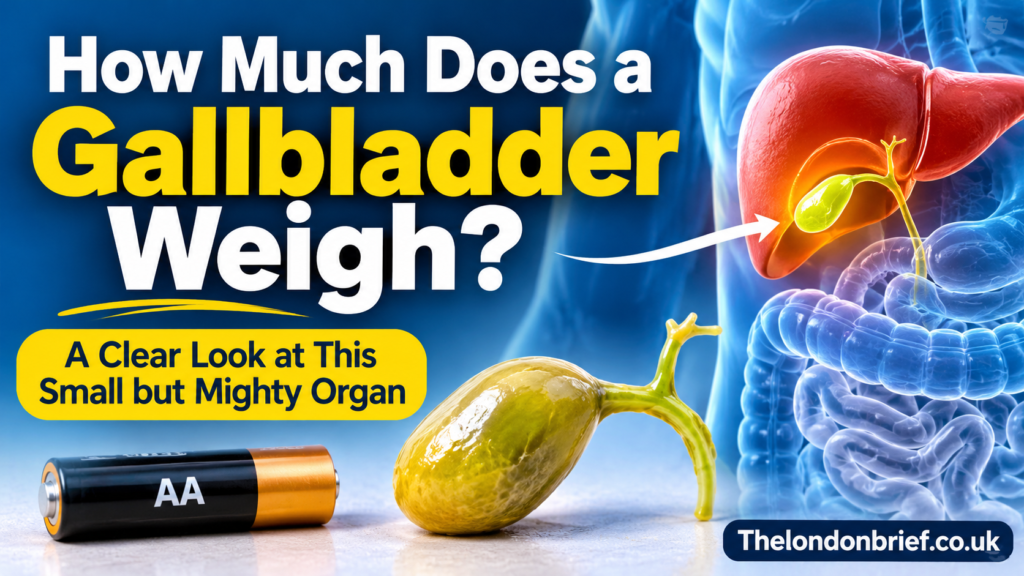

If you have ever wondered how much does a gallbladder weigh, you are in good company. The question usually comes up after an ultrasound, a surgery recommendation, or a pathology report that lists a strange number in grams. A healthy, empty adult gallbladder is light, often only around 10 to 25 grams, which is less than a single AA battery. This guide explains what shapes that number and why it matters.
What Is the Gallbladder?
The gallbladder is a small, pear-shaped pouch tucked beneath the liver on the upper right side of your abdomen. It stores bile, a greenish-yellow fluid that helps your body break down fats. Most adults have a gallbladder roughly 7 to 10 centimeters long (about 3 to 4 inches) and around 4 centimeters wide at its broadest point.
Many people picture it as a bulky organ because it gets so much attention when it causes pain. In reality it is one of the smaller digestive organs, and its modest size is part of why gallbladder problems can feel so sharp.
How Much Does a Gallbladder Weigh in a Healthy Adult?
There is no single official figure, because organ weight varies from person to person. Still, pathology references and anatomy texts point to a fairly consistent picture. A normal gallbladder with its contents drained usually weighs somewhere between 10 and 25 grams, which is under one ounce.
The weight depends on how you measure it. Surgeons and pathologists often weigh the organ after removal, once the bile has been emptied. Researchers weighing it in the body or with fluid inside will get a higher number. Because of this, you may see slightly different ranges in different medical sources, and that is normal rather than a sign that anyone is wrong.
Empty Versus Full: Why the Number Changes
A gallbladder can hold roughly 30 to 50 milliliters of bile, which is about one to one and a half fluid ounces. Bile is close to water in density, so that fluid adds roughly 30 to 50 grams on top of the organ’s own tissue weight.
The Role of Meals
Your gallbladder is not a fixed object. After a fatty meal, a hormone called cholecystokinin signals it to contract and release bile into the small intestine. It shrinks and lightens as it empties, then slowly refills between meals. Someone fasting overnight will have a fuller, heavier gallbladder than someone who has just finished dinner.
What Affects Gallbladder Weight?
Several everyday factors influence the figure, which is why doctors treat any measurement as a rough guide instead of a strict rule.
Body size plays a part. A larger frame generally comes with larger organs, and a smaller adult or a child will have a lighter gallbladder. A newborn’s gallbladder is tiny, only a few centimeters long, and it grows along with the rest of the body.
Age and sex have a mild influence as well. Studies of organ size suggest small differences between men and women, though the overlap is large enough that no one should worry about being above or below an average.
Health is the biggest variable. An inflamed or scarred gallbladder behaves very differently from a healthy one, and that is where the numbers start to climb.
When Disease Changes the Weight
A gallbladder under strain can get noticeably heavier. In cholecystitis, the organ becomes inflamed, the wall swells, and fluid builds up in the surrounding tissue. A healthy wall is usually 3 millimeters thick or less. A thickened wall adds real mass.
Gallstones and Added Weight
Gallstones also add weight. They form when substances in bile, most often cholesterol, harden into particles. Some are as small as a grain of sand, while others grow to the size of a golf ball. A gallbladder packed with stones can weigh far more than a normal one, and the stones alone sometimes account for tens of grams.
Long-standing inflammation can also scar and thicken the wall, a condition called chronic cholecystitis. Pathologists often note increased weight and wall thickness when they examine a removed gallbladder, which helps them confirm what the surgeon saw.
How the Gallbladder Gets Measured
Weight is rarely the first thing a doctor checks in a living patient. Imaging tools such as ultrasound, CT scans, and MRI look at size, wall thickness, and the presence of stones. These details tell a clinician much more about function than a raw weight ever could.
Weight becomes a standard measurement after surgery. When the organ is sent to the lab, the pathology team records its dimensions and weight in grams, then examines the tissue under a microscope. If you have seen a number on your report and wondered whether it is normal, ask your surgeon or physician to explain it in the context of your condition.
Why Bile Matters So Much
Your liver makes about half a liter to a liter of bile every day. The gallbladder concentrates this fluid, making it stronger and more efficient. When you eat fat, the stored bile is released into the small intestine, where it breaks fat into smaller droplets so your body can absorb it along with fat-soluble vitamins like A, D, E, and K.
This explains why such a small, light organ has a big job. Its weight tells you little about its importance, only that it is built for storage and quick delivery rather than bulk.
Living Without a Gallbladder
Here is something many people find reassuring: you can live a perfectly normal life without one. Gallbladder removal, called cholecystectomy, is among the most common surgeries performed worldwide, and most people recover quickly, especially after the keyhole approach known as laparoscopic surgery.
After removal, bile flows directly from the liver into the small intestine instead of being stored first. Some people notice looser stools or mild digestive changes for a while, particularly after rich or greasy meals. Most adapt within weeks to months. A balanced diet with moderate fat intake usually helps.
Signs You Should Not Ignore
Learning how much a gallbladder weighs is interesting, but knowing the warning signs is more useful. Steady pain in the upper right abdomen or just below the breastbone, especially after eating, can point to gallstones. Nausea, bloating, and pain that spreads to the right shoulder or back are also common.
Some symptoms need urgent care. Fever with chills, yellowing of the skin or eyes, very dark urine, pale stools, or severe pain that lasts more than a few hours can signal infection or a blocked bile duct. Do not wait these out at home. A doctor can order the right tests and guide you to the best treatment.
Keeping Your Gallbladder Healthy
You cannot control every risk factor, since genetics, age, and sex all play a role. Women, people over 40, and those with a family history of gallstones face higher odds. But everyday habits do help.
Maintaining a healthy weight matters, and gradual loss is safer than crash dieting, which can trigger stone formation. Eating plenty of fiber, vegetables, and healthy fats such as olive oil and nuts supports good digestion. Staying active and drinking enough water also contribute to a healthier digestive system overall.
Frequently Asked Questions
How much does a gallbladder weigh after removal?
A removed gallbladder is usually weighed by a pathology lab, and a healthy one commonly comes in at around 10 to 25 grams once the bile has drained. A diseased gallbladder with a thick wall or stones can weigh considerably more.
Is the gallbladder the smallest organ in the body?
No. The pineal gland and the parathyroid glands are smaller. The gallbladder is small compared with the liver or stomach, but it is not the smallest.
Can a gallbladder grow larger than normal?
Yes. Blockage of the bile duct, inflammation, or a large number of stones can cause the gallbladder to swell. Doctors identify this on imaging and decide whether treatment or surgery is needed.
Does gallbladder weight affect how it works?
Not directly. Doctors care more about wall thickness, stone presence, and how well the organ empties than about weight alone.
Do you need to worry about your gallbladder’s weight?
Almost never. For most people, weight is only measured after surgery. Focus on symptoms and follow your doctor’s advice rather than on the number itself.
Final Thoughts
So, how much does a gallbladder weigh? In a healthy adult, the empty organ is usually only about 10 to 25 grams, and the bile inside can roughly double that figure. Illness, stones, and inflammation push the number higher. Whatever the exact weight, this small pouch does a major job in digestion, and with good habits and prompt medical attention when symptoms appear, most people keep their digestive health on track, with or without it. If something feels off, speak with a qualified healthcare provider instead of guessing.