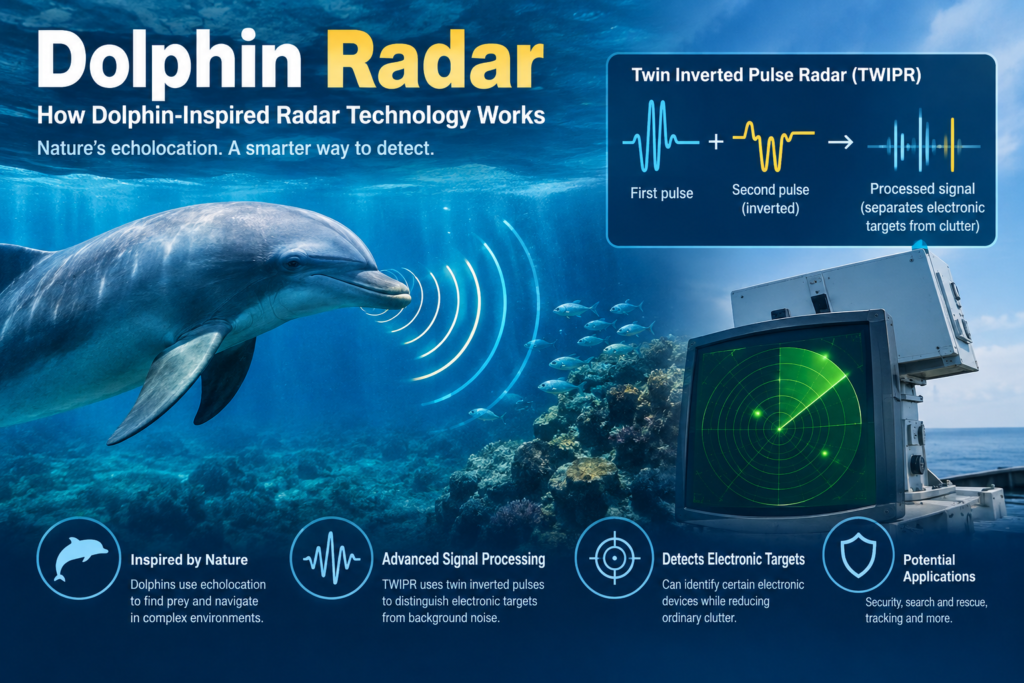

What Is Dolphin Radar?
Dolphin radar is a fascinating example of how an ability found in nature can inspire advanced human technology. Dolphins use echolocation to understand their underwater surroundings, locate prey, and distinguish useful signals from confusing background noise. Scientists have studied this remarkable biological system for years, and some of those ideas have been adapted into radar and sonar technologies.
One of the most interesting developments is known as Twin Inverted Pulse Radar, or TWIPR. Unlike ordinary radar, which generally looks for reflections from objects, this approach is designed to help distinguish particular electronic targets from surrounding objects that could otherwise create confusing radar returns. Researchers at the University of Southampton, University College London, and Cobham Technical Services investigated the technology and published experimental findings in Proceedings of the Royal Society A.
The story behind this technology is especially interesting because it begins not with computers or military equipment, but with the hunting behavior of dolphins.
How Dolphins Use Echolocation
Dolphins live in an environment where visibility can change dramatically. Murky water, darkness, suspended particles, and underwater bubbles can make visual detection difficult. Instead of depending only on their eyes, dolphins use sound as a powerful sensory tool.
A dolphin produces rapid clicking sounds and listens to the echoes that return after those sounds encounter objects. By interpreting the returning signals, the animal can gather information about the location and characteristics of objects around it.
This ability is called echolocation, and it is a form of biological sonar. The returning sound contains information about distance, direction, movement, and the nature of the object that produced the echo.
Researchers became particularly interested in how dolphins can identify prey even when their surroundings contain large amounts of acoustic interference.
The Bubble-Net Mystery
Some dolphins use bubbles as part of hunting strategies. When bubbles surround prey, they can create a difficult acoustic environment because bubbles scatter sound strongly. From an engineering perspective, this raises an obvious question: how can a dolphin separate the useful echo from the confusing bubble-generated signals?
Scientists investigating this problem developed sonar techniques based on the idea of using pairs of pulses with different polarity. This research eventually helped inspire the radar technique known as TWIPR.
The important point is that scientists did not simply copy a dolphin’s sonar system and place it inside a radar machine. Instead, they studied a physical principle associated with signal discrimination and adapted that principle to electromagnetic radar.
How Twin Inverted Pulse Radar Works
Traditional radar sends electromagnetic energy toward an environment and analyzes the returning signals. Objects such as metal surfaces, structures, vegetation, and other materials can produce reflections. In a complicated environment, these unwanted returns are commonly described as clutter.
The challenge is not always detecting something. Sometimes the harder task is determining whether a detected signal comes from the object that matters.
TWIPR approaches this problem using two closely spaced pulses. The second pulse is essentially an inverted version of the first. When the signals interact with ordinary linear-scattering objects, their responses can cancel under the appropriate processing.
Electronic components can behave differently because semiconductor junctions have nonlinear electrical characteristics. This difference gives the radar system a way to separate certain electronic targets from ordinary clutter.
That distinction is what makes the technology unusual. Rather than simply making every reflection stronger, the system attempts to make the type of reflection more informative.
Why Dolphins Inspired the Technology
The connection between dolphins and radar may initially sound strange because dolphins use sound while radar uses electromagnetic waves. In reality, the connection is based on the broader idea of signal processing.
Dolphins have evolved biological systems capable of extracting useful information from complicated acoustic environments. Engineers can study such natural systems and ask whether similar mathematical or physical principles can be transferred into machines.
The research behind TWIPR followed this type of thinking. Scientists first developed twin inverted pulse concepts for sonar, where the challenge involved separating targets from bubble-related interference. They then explored whether a comparable approach could work with electromagnetic waves.
This is an excellent example of biomimicry, where observations from nature influence the development of engineering solutions.
What Can Dolphin Radar Detect?
The scientifically documented TWIPR research was not primarily designed to track dolphins. Its purpose was quite different. Researchers investigated whether the technology could distinguish electronic circuitry from conventional metallic clutter.
Experimental work included targets such as a dipole with a diode and examples involving mobile phones. The research showed that particular electronic targets could produce distinctive responses compared with ordinary metallic objects.
This opens interesting possibilities for situations where conventional radar or metal detection may produce too many unwanted signals.
Potential applications discussed by researchers include finding concealed electronic equipment, detecting certain devices associated with explosives, and locating electronic equipment in difficult environments.
The researchers also discussed possible rescue applications. Because electronic devices can sometimes remain detectable even when they are switched off or their batteries have lost power, the technique could potentially assist in locating people carrying suitable electronic equipment.
These applications should not be confused with a claim that TWIPR is a universal search system. Its performance depends on the target, environment, system design, and signal-processing conditions.
Dolphin Radar Is Not Ordinary Marine Radar
One common misunderstanding is that dolphin radar simply means a radar system that tracks dolphins in the ocean. That is not an accurate description of the best-documented technology associated with the term.
Marine radar can certainly be used around dolphins and other objects near the surface, but radar and sonar have different physical principles. Radar uses electromagnetic waves, while sonar uses sound waves.
The dolphin-inspired TWIPR concept is specifically interesting because it transfers an idea developed from sonar research into electromagnetic radar.
That distinction matters because it prevents the technology from being presented as something it is not. The most important innovation is the method of distinguishing different types of scattering rather than simply detecting a dolphin underwater.
Why Clutter Is Such a Big Problem
Radar systems operate in environments filled with reflections. A building, tree, metal object, vehicle, pipe, or piece of debris may all produce signals. When the desired target is small or unusual, these unwanted returns can make detection more difficult.
This is known as the clutter problem.
The 2013 peer-reviewed study on TWIPR specifically investigated whether twin inverted pulses could improve target discrimination. The researchers tested several targets and compared electronic targets with metallic objects representing clutter.
The results suggested that the technique could produce a much stronger response from certain nonlinear electronic targets than from ordinary metallic clutter under the tested conditions.
That does not mean the technology automatically identifies every electronic device in every environment. Scientific experiments demonstrate possibilities under defined conditions, while real-world systems require additional engineering, testing, calibration, and validation.
Potential Uses in the Real World
The most intriguing feature of this technology is its ability to focus attention on certain types of electronic circuitry rather than treating every reflective object as equally important.
For security applications, that principle could potentially help locate concealed electronic equipment in places where ordinary radar produces excessive clutter. Researchers have also considered applications involving buried devices and rescue situations.
Another interesting possibility involves tracking. The published research discussed small electronic devices that could act as detectable targets without requiring large batteries. Such concepts could potentially support specialized tracking applications where identifying a particular electronic signature is more useful than simply locating a large physical object.
However, these possibilities should be viewed as research and engineering applications rather than promises of a commercially universal detection device.
The Science Behind the Fascination
What makes dolphin radar so compelling is not simply the technology itself. It represents a different way of thinking about engineering.
Nature often solves difficult problems through adaptation rather than brute force. Dolphins have developed sophisticated acoustic abilities over millions of years of evolution. Engineers can observe those abilities, identify useful principles, and attempt to reproduce selected aspects through mathematics, electronics, and signal processing.
TWIPR demonstrates how an observation about animal behavior can eventually influence a completely different technological field.
The technology also shows why scientific terminology needs to be used carefully. Calling something “dolphin radar” can make it sound as though dolphins are directly operating radar or that radar can see underwater exactly like a dolphin’s echolocation. Neither description is accurate.
The real story is more interesting: researchers studied biological sonar, developed related signal-processing concepts, and explored how those concepts could be applied to radar.
What Does the Future Hold?
The future of dolphin-inspired sensing is likely to involve increasingly sophisticated signal processing, better sensors, and more powerful computing systems. Machine learning and advanced digital processing could potentially help researchers identify subtle patterns that older systems struggled to separate.
At the same time, researchers must continue testing such systems under realistic conditions. Laboratory performance does not automatically translate into reliable field performance. Factors such as distance, interference, target orientation, materials, weather, and surrounding structures can all affect detection.
The most valuable lesson may therefore be broader than any single radar device. Studying dolphins demonstrates that nature can provide ideas for solving engineering problems that appear difficult using conventional approaches.
Frequently Asked Questions
Is dolphin radar actually used by dolphins?
No. Dolphins do not use human-made radar. They use biological echolocation, which is a form of natural sonar based on sound.
What is TWIPR?
TWIPR stands for Twin Inverted Pulse Radar. It uses two closely spaced pulses with opposite polarity and processes their responses to help distinguish certain nonlinear electronic targets from ordinary clutter.
Why are dolphins connected to TWIPR?
The connection comes from research into dolphin-inspired sonar. Scientists studied how acoustic signals could distinguish targets from difficult bubble-related clutter and explored whether related principles could work with electromagnetic radar.
Can dolphin radar find every hidden electronic device?
No. The technology is designed around particular physical properties of targets and depends on operating conditions. It should not be presented as a universal detector.
Could this technology help rescue operations?
Researchers have discussed possible rescue applications, particularly because certain electronic devices may remain detectable even when switched off or without battery power. Practical performance depends on the specific system and circumstances.
Conclusion
Dolphin radar is a powerful example of the unexpected relationship between biology and engineering. Dolphins use echolocation to interpret complicated underwater environments, and researchers have taken inspiration from those principles to develop advanced signal-processing approaches such as Twin Inverted Pulse Radar.
The technology is not a literal dolphin-powered radar system, nor is it simply a machine for tracking marine mammals. Its real importance lies in the idea of distinguishing useful targets from confusing background signals. Research published by scientists from the University of Southampton and partner institutions demonstrated how twin inverted pulses could help identify certain electronic targets while reducing the influence of ordinary metallic clutter.
As sensing technology continues to evolve, nature will likely remain an important source of inspiration. The story of dolphin radar shows that sometimes a solution to a difficult engineering problem can begin by carefully observing how an animal already solves a similar challenge.