
Introduction
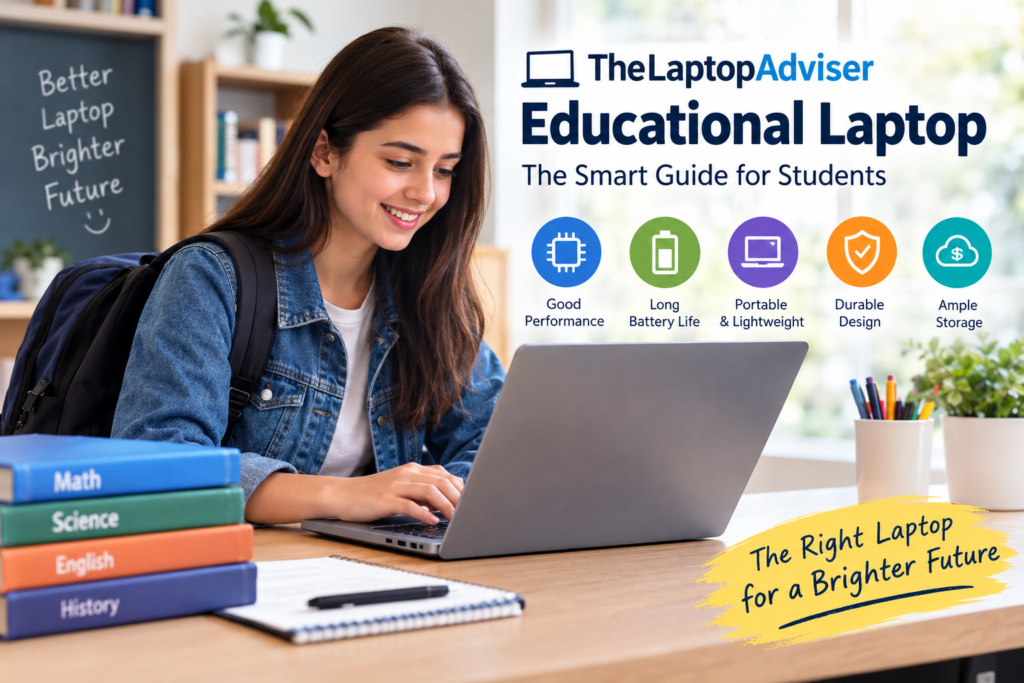
Finding the right laptop for school or college can be difficult when every model offers different processors, memory, screens, and battery claims. The Laptop Adviser’s educational laptop concept is simple: students need a computer that is reliable, portable, durable, and capable of handling everyday academic work. The Laptop Adviser has an education-focused section that discusses laptops for students and different study requirements.
A useful student laptop does not always need the most expensive hardware. For many learners, the important things are smooth web browsing, comfortable typing, dependable battery life, a clear screen, and enough storage for documents and school projects. Understanding these practical requirements can make the buying process much easier.
What Is TheLaptopAdviser Educational Laptop?
The phrase The Laptop Adviser educational laptop refers to the education-focused laptop guidance published by The Laptop Adviser. Its education laptop content covers devices for students, teachers, schools, and home learning. The site describes its broader purpose as helping readers make informed laptop purchasing decisions through laptop reviews and buying information.
The site’s recent education guides emphasize everyday classroom needs rather than chasing the highest specifications. Their discussions include performance, battery life, durability, portability, operating systems, storage, and compatibility with educational software. These considerations matter because a laptop used every day for school must work well in real situations, not just look impressive on a specification sheet.
Why Students Need the Right Laptop
A laptop can become an important part of modern education. Students may use the same machine to write assignments, research information, attend online classes, create presentations, watch educational videos, and communicate with teachers or classmates.
This is why buying decisions should begin with the student’s actual workload. A child who mainly uses browser-based learning platforms does not necessarily need the same hardware as a university student studying engineering, computer science, video production, or graphic design.
The Laptop Adviser’s education content also separates needs by educational level and workload. Its recent guidance discusses simpler devices for younger students and more capable Windows or Mac systems for students who require demanding applications.
Performance That Makes Sense for Schoolwork
Processor performance is one of the first specs buyers notice, but the fastest available processor isn’t always necessary. For ordinary school activities such as documents, web research, presentations, video calls, and cloud applications, a modern entry-level or mid-range processor can provide a practical experience.
RAM is equally important because students often keep multiple browser tabs and applications open at once. The Laptop Adviser suggests 8 GB of RAM as a useful baseline for many middle- and high-school workloads, while heavier users can benefit from 16 GB.
Storage also deserves attention. An SSD generally provides faster startup and file access than older mechanical storage, while 256 GB can be a reasonable starting point for many students. However, students working with large video, design, engineering, or scientific files may need considerably more capacity.
Battery Life and Portability Matter
Students often carry their laptops between classrooms, libraries, homes, and study spaces. A powerful but heavy machine can become inconvenient when it has to travel every day.
Battery life is therefore an important part of the laptopadviser educational laptop discussion. Recent guidance from the site uses around eight hours of mixed use as a practical target for many student devices. However, real battery life varies according to screen brightness, applications, wireless activity, battery condition, and manufacturer testing methods.
Screen size also involves a trade-off. Smaller screens can make laptops easier to carry, while larger displays may be more comfortable for lengthy writing, spreadsheets, research, and creative projects. A 13- to 15-inch range can offer a useful balance for many students.
Durability Should Not Be Ignored
School life can be demanding for technology. Laptops may go into backpacks, move between desks, and be used in different environments throughout the day. A fragile device can become expensive if it needs frequent repairs.
The Laptop Adviser’s recent educational material highlights features such as reinforced construction, spill-resistant keyboards, and service-friendly designs as useful considerations for educational environments.
Parents and schools should also examine warranty coverage and repair options before purchasing. A laptop that costs slightly more but offers dependable support may provide better long-term value than a cheaper device that is difficult to repair.
Choosing Between Windows, macOS, and ChromeOS
The operating system should match the student’s applications. Windows laptops offer broad software compatibility and are commonly used for general productivity, technical programs, and many specialist applications. macOS can be useful for students already working within Apple’s ecosystem and for certain creative workloads.
Chromebooks are another option, especially when most schoolwork happens through web applications and cloud services. The Laptop Adviser has discussed Chromebooks as suitable choices for younger students because of their simplicity and ease of use.
Before buying any laptop, students and parents should check the school’s or university’s software requirements. A relatively powerful computer is not helpful if an essential course application cannot run properly on its operating system.
The Right Laptop Depends on the Student
No single educational laptop works perfectly for every learner. An elementary student may mainly need a simple machine for reading, educational websites, typing, and classroom activities. A high school student might need additional performance for programming, presentations, research, or creative projects.
College students often have more specialized requirements. Someone studying business may need strong spreadsheet performance, while a design student could require better graphics capability and display quality. Engineering and scientific students may need hardware that can handle specialized software.
This is why the laptopadviser educational laptop approach works as a buying framework rather than a one-size-fits-all answer. The goal is to match specifications to real academic tasks instead of buying features you may never use.
How to Get Better Value
A sensible laptop purchase starts with a realistic budget. Instead of paying extra for every premium feature, buyers should identify the specifications that will directly improve the student’s daily work.
For many students, spending money on adequate RAM, an SSD, a comfortable keyboard, reliable battery life, and a good warranty can be more practical than choosing an expensive processor that the student rarely uses. Recent The Laptop Adviser guides similarly emphasize balancing performance, price, durability, and long-term usefulness.
It is also worth checking upgrade and repair possibilities. If memory or storage can be replaced or expanded, the laptop may remain useful for longer. Buyers should also consider accessories such as a protective sleeve, charger, and external storage when necessary.
Everyday Habits Can Extend Laptop Life
Even a well-built laptop needs proper care. Students should avoid blocking ventilation openings, protect the device during transportation, and keep liquids away from the keyboard. Regular operating-system and application updates also help maintain security and compatibility.
Battery habits can make a difference, too. Lowering screen brightness when appropriate, closing unused applications, and using sleep mode between classes can reduce unnecessary power consumption.
A padded laptop sleeve is another simple investment. It can protect against the small knocks and pressure that commonly occur when a device is carried in a school or college bag.
What Makes the Laptop Adviser Approach Useful?
The Laptop Adviser says its goal is to provide comprehensive, unbiased laptop information for people with different needs, including students and professionals. Its education section contains material covering student laptops, specialized academic workloads, and practical buying considerations.
Its newer education guides also discuss real-world factors such as web research, document editing, video calls, battery testing, keyboard usability, ports, wireless connectivity, warranty terms, and school compatibility.
These details are more useful to buyers than focusing on processor names alone. A student needs a machine that fits daily life, supports required software, and remains dependable throughout the academic year.
Frequently Asked Questions
What is the Laptop Adviser educational laptop?
The phrase describes The Laptop Adviser’s education-focused laptop guidance for students, teachers, families, and schools. The material covers specifications and practical factors involved in selecting laptops for learning.
How much RAM does a student laptop need?
For many general school and high-school tasks, 8 GB is a practical starting point. Students running demanding software or many applications at once may benefit from 16 GB.
Is a Chromebook suitable for students?
A Chromebook can be suitable when the student’s schoolwork mainly uses web applications, cloud documents, and browser-based learning platforms. Compatibility should always be checked before purchase.
What storage is suitable for education?
A 256 GB SSD can work well for many students who mainly store documents and use cloud services. Students working with large media or technical files may need more storage.
What should parents check before buying?
Parents should consider the student’s applications, processor, RAM, SSD capacity, screen size, battery life, durability, operating system, warranty, and repair options. They should also check the school’s technology requirements before making a final purchase.
Conclusion
The Laptop Adviser educational laptop topic is ultimately about choosing technology around the student’s real needs rather than simply buying the most powerful machine available. Performance, battery life, portability, durability, storage, operating-system compatibility, and long-term support all contribute to a useful educational computer.
The Laptop Adviser’s education resources provide a starting point for understanding these factors and comparing different types of student laptops. The best purchase decision comes from matching those practical considerations with the learner’s age, subjects, software requirements, budget, and everyday study habits. When you consider those details carefully, a laptop can become a dependable learning companion rather than just another piece of technology.