
Introduction
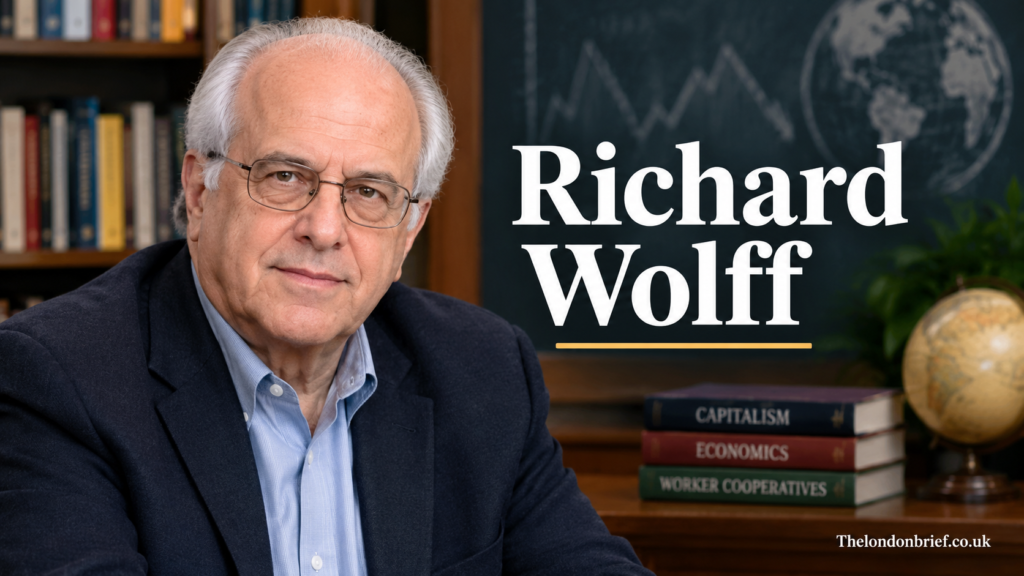
Richard Wolff is an American economist, professor, author, and public speaker known for his critical views on capitalism, economic inequality, and the relationship between workers and business owners. Through his books, lectures, interviews, and public discussions, he has encouraged people to question how modern economies operate and who benefits most from economic growth.
Unlike economists who focus mainly on markets, government policies, or financial statistics, Wolff places considerable attention on workplace relationships, ownership, and the distribution of wealth. His explanations often explore why economic crises happen and how ordinary workers experience their effects.
Over several decades, he has developed a recognizable voice in public economic debates. His work attracts students, workers, political commentators, and readers interested in alternatives to the traditional capitalist system.
Who Is Richard Wolff?
Richard Wolff is an American Marxian economist whose research and public commentary focus on capitalism, class relations, economic crises, and democratic approaches to workplace organization. He became widely known outside academic circles through his accessible lectures and discussions about the causes of financial instability and growing economic inequality.
Wolff does not simply explain economic events as isolated problems. Instead, he examines the structures behind them, including who owns businesses, who makes important decisions, and how profits are distributed. This approach distinguishes his work from many conventional economic explanations.
His arguments have made him a recognizable figure among people seeking a deeper understanding of the modern economy. Supporters value his willingness to challenge established ideas, while critics question some of his conclusions and proposed alternatives.
Early Life and Education
Richard Wolff was born on April 1, 1942, in Youngstown, Ohio, United States. His family background and education helped shape his intellectual development, particularly his interest in political institutions, social relationships, and economic systems.
Wolff pursued higher education at several respected institutions. He earned his undergraduate degree from Harvard University in 1963, followed by a master’s degree from Stanford University in 1964. He later completed a master’s degree at Yale University in 1967 and received his doctorate in economics from Yale in 1969.
His academic journey provided him with a strong foundation in economic theory, historical analysis, and social science. Studying at different universities also exposed him to a range of intellectual traditions and approaches to understanding society.
Rather than limiting his interests to conventional economic models, Wolff became increasingly interested in Marxian economics. This tradition examines how production, ownership, labor, and class relationships influence economic outcomes.
Richard Wolff’s Academic Career
Richard Wolff built much of his professional reputation through university teaching and research. He taught economics at the University of Massachusetts Amherst from 1973 until 2008, where he worked with students and contributed to discussions about political economy.
His teaching emphasized the importance of examining economic institutions in their historical and social contexts. He encouraged students to consider how ownership structures affect decisions about wages, working conditions, investment, and production.
After leaving his full-time university position, Wolff continued his educational work through lectures, public appearances, writing, and independent media. This allowed him to reach audiences beyond traditional classrooms.
His academic background remains an important part of his public identity. Although he frequently discusses controversial economic questions, his arguments are rooted in a sustained engagement with economic theory and the history of capitalism.
Understanding His Economic Ideas
One of the central themes in Wolff’s work is that economic systems should be evaluated by examining how they organize production and distribute power. He argues that understanding markets alone is not enough to explain the experiences of workers and business owners.
His Criticism of Capitalism
Wolff argues that capitalism gives business owners considerable control over workplaces because they own or control the resources used to produce goods and services. Workers generally receive wages in exchange for their labor, while business owners determine how much of the resulting revenue is retained as profit, reinvested, or distributed.
In his view, this arrangement creates an unequal relationship between employees and employers. Workers may have limited influence over major decisions affecting their jobs, even when those decisions shape their financial security and everyday lives.
He also connects this structure to recurring economic problems, including unemployment, financial instability, and the concentration of wealth. Wolff believes that these difficulties cannot always be solved by adjusting individual policies without examining the underlying economic system.
However, economists disagree about how much these outcomes are caused by capitalism itself. Other economic approaches emphasize the benefits of competition, entrepreneurship, private investment, and market-based coordination. Understanding this disagreement is essential to evaluating his arguments fairly.
His Views on Economic Inequality
Economic inequality is another major subject in Wolff’s public commentary. He questions why substantial wealth can accumulate among business owners and investors while many employees struggle with housing costs, healthcare expenses, and financial uncertainty.
He argues that income differences reflect more than individual effort or talent. Ownership, bargaining power, access to investment opportunities, and the organization of production also influence who receives economic rewards.
His perspective encourages readers to look beyond headline figures about economic growth. An economy can produce more goods and services without distributing the benefits equally among its population.
Although the extent and causes of inequality vary across countries and periods, Wolff’s work keeps attention on an important question: how should the benefits of economic activity be shared?
Worker Cooperatives and Workplace Democracy
One of Richard Wolff’s best-known proposals is the expansion of worker cooperatives. These are businesses in which employees collectively own or democratically govern the enterprise, according to the particular cooperative’s rules.
In a conventional company, important decisions are generally controlled by owners, executives, or appointed managers. In a worker cooperative, employees may have a direct role in deciding how the business operates, how income is distributed, and how major workplace questions are addressed.
Wolff argues that this model could reduce the divide between workers and owners by giving employees greater responsibility and control over production. He believes that workplace democracy deserves more attention as a possible alternative to conventional corporate organization.
Cooperatives already operate in different industries around the world, demonstrating that collective ownership is a practical business arrangement rather than merely a theoretical concept.
Nevertheless, worker cooperatives face challenges. They may struggle to obtain financing, manage disagreements, compete with larger companies, and balance democratic participation with efficient decision-making. Their success depends on effective governance, sound financial management, and the circumstances of the industry in which they operate.
Wolff’s interest in cooperatives reflects his broader belief that economic democracy should extend beyond political elections into the places where people work.
Books and Public Education
Richard Wolff has written and co-authored several books exploring capitalism, Marxian economics, and the organization of modern economies. His work often combines theoretical discussion with historical examples to explain how economic systems develop and why they encounter recurring difficulties.
Among his notable publications is Democracy at Work: A Cure for Capitalism, which presents his argument for expanding democratic ownership and decision-making in workplaces. The book introduces readers to worker cooperatives and explains why he considers them important to economic reform.
He has also co-authored Contending Economic Theories: Neoclassical, Keynesian, and Marxian, which compares influential traditions in economic thought. This work helps readers understand how different schools of economics approach markets, employment, production, and economic instability.
Through his writing, Wolff seeks to make complex ideas accessible to readers who may not have formal training in economics. His public lectures and interviews serve a similar purpose, connecting abstract theories to familiar experiences such as layoffs, rising prices, and wage negotiations.
The Economic Update Program
Wolff is associated with Economic Update, a public education program that discusses current economic developments through a critical political-economy perspective. The program examines topics such as employment, corporate power, government decisions, inequality, and international economic relationships.
Its format helps introduce economic discussions to people who might not regularly read academic journals or specialized textbooks. Wolff often uses contemporary events to explain larger patterns in economic organization.
His communication style is direct and conversational, making complicated issues easier to follow. Rather than treating economic developments as disconnected news stories, he attempts to explain the structural forces he believes influence them.
This approach has helped him build an audience through independent media, interviews, lectures, and online video platforms. It has also brought his ideas into wider public debates about the future of work and the distribution of wealth.
Richard Wolff’s Influence and Criticism
Richard Wolff has influenced discussions about capitalism by presenting economic questions in terms that ordinary readers can understand. His work appeals particularly to people concerned about job insecurity, unequal wealth distribution, corporate influence, and the effects of financial crises on households.
He has also encouraged renewed interest in Marxian economics, a tradition that remains influential in debates about labor, ownership, and political economy.
At the same time, his proposals are not universally accepted. Critics argue that market competition, private ownership, and entrepreneurship can encourage innovation and economic growth. Others question whether worker cooperatives could operate effectively across every industry or whether democratic decision-making would resolve the economic problems Wolff identifies.
These disagreements highlight the importance of distinguishing between established facts, economic interpretations, and policy proposals. Wolff’s academic background gives him a foundation for discussing economic systems, but individual claims still need to be assessed through evidence and comparison with competing explanations.
His broader contribution is to encourage people to ask difficult questions about who controls economic resources and how society might organize production differently.
Personal Life and Public Image
Richard Wolff generally maintains a public profile centered on his professional work, political economy, and educational activities. Compared with entertainers and mainstream celebrities, his recognition comes primarily from his lectures, books, interviews, and commentary on economic issues.
He is married to Harriet Fraad, a psychotherapist and writer whose work explores psychological and social questions. Their professional interests intersect around broader discussions of society, human behavior, and economic life.
Wolff’s public image is closely associated with his distinctive explanations of capitalism and his willingness to challenge widely accepted economic assumptions. He speaks to audiences interested in both the practical effects of economic policy and the deeper structures that shape everyday working life.
Frequently Asked Questions
What Is Richard Wolff Known For?
Richard Wolff is best known as an American Marxian economist who criticizes capitalism, studies economic inequality, and advocates greater workplace democracy through worker cooperatives.
Where Did Richard Wolff Study?
He studied at Harvard University, Stanford University, and Yale University. He earned his doctorate in economics from Yale in 1969.
What Does Richard Wolff Believe About Capitalism?
Wolff argues that capitalism concentrates control over production among business owners and contributes to inequalities between owners and workers. He supports exploring democratic alternatives to conventional workplace ownership.
What Is Richard Wolff’s Most Famous Book?
One of his best-known books is Democracy at Work: A Cure for Capitalism, which explores worker cooperatives and democratic approaches to business ownership.
Does Richard Wolff Support Worker Cooperatives?
Yes. He advocates worker cooperatives because they can give employees greater control over workplace decisions, ownership, and the distribution of business income.
Conclusion
Richard Wolff has established himself as an influential voice in debates about capitalism, economic inequality, and the future of work. His academic career, books, and public education efforts have introduced Marxian economic ideas to audiences far beyond university classrooms.
His central message is that understanding the economy requires looking closely at ownership, workplace authority, and the distribution of wealth, not just prices and markets. While his criticism of capitalism and his proposed alternatives remain subjects of debate, his work encourages readers to examine economic institutions rather than accept them as inevitable.
For anyone interested in how businesses operate, why economic inequality persists, and whether workplaces can become more democratic, Richard Wolff offers a distinctive perspective worth examining alongside other economic viewpoints.